README

**The lightweight PyTorch wrapper for high-performance AI research. Scale your models, not the boilerplate.**
______________________________________________________________________
Website �?� Key Features �?� How To Use �?� Docs �?� Examples �?� Community �?� Lightning AI �?� License
[](https://pypi.org/project/pytorch-lightning/) [](https://badge.fury.io/py/pytorch-lightning) [](https://pepy.tech/project/pytorch-lightning) [](https://anaconda.org/conda-forge/pytorch-lightning) [](https://hub.docker.com/r/pytorchlightning/pytorch_lightning) [](https://codecov.io/gh/Lightning-AI/lightning)
[](https://pytorch-lightning.readthedocs.io/en/stable/) [](https://www.pytorchlightning.ai/community) [](https://github.com/Lightning-AI/lightning/blob/master/LICENSE)
###### \\*Codecov is > 90%+ but build delays may show less
______________________________________________________________________
## PyTorch Lightning is just organized PyTorch
Lightning disentangles PyTorch code to decouple the science from the engineering. 
______________________________________________________________________
## Lightning Design Philosophy
Lightning structures PyTorch code with these principles:
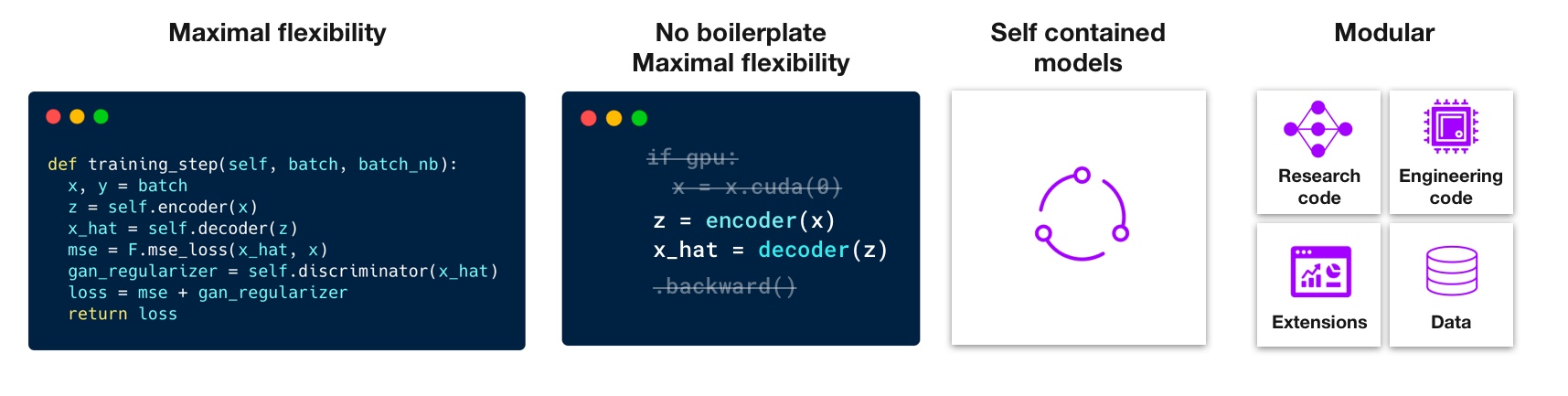
Lightning forces the following structure to your code which makes it reusable and shareable:
- Research code (the LightningModule). - Engineering code (you delete, and is handled by the Trainer). - Non-essential research code (logging, etc... this goes in Callbacks). - Data (use PyTorch DataLoaders or organize them into a LightningDataModule).
Once you do this, you can train on multiple-GPUs, TPUs, CPUs, IPUs, HPUs and even in 16-bit precision without changing your code!
[Get started in just 15 minutes](https://pytorch-lightning.readthedocs.io/en/latest/starter/introduction.html)
______________________________________________________________________
## Continuous Integration
Lightning is rigorously tested across multiple CPUs, GPUs, TPUs, IPUs, and HPUs and against major Python and PyTorch versions.
Current build statuses
| System / PyTorch ver. | 1.10 | 1.12 | | :------------------------: | :-------------------------------------------------------------------------------------------------------------------------------------------------------------------------------------------------------------------------------: | :--------------------------------------------------------------------------------------------------------------------------------------------------------------------------------------------------------------: | | Linux py3.7 \\[GPUs\\*\\*\\] | - | - | | Linux py3.7 \\[TPUs\\*\\*\\*\\] | - | - | | Linux py3.8 \\[IPUs\\] | - | - | | Linux py3.8 \\[HPUs\\] | [](https://dev.azure.com/Lightning-AI/lightning/_build/latest?definitionId=26&branchName=master) | - | | Linux py3.{7,9} | - | [](https://github.com/Lightning-AI/lightning/actions/workflows/ci-tests-pytorch.yml) | | OSX py3.{7,9} | - | [](https://github.com/Lightning-AI/lightning/actions/workflows/ci-tests-pytorch.yml) | | Windows py3.{7,9} | - | [](https://github.com/Lightning-AI/lightning/actions/workflows/ci-tests-pytorch.yml) |
- _\\*\\* tests run on two NVIDIA P100_ - _\\*\\*\\* tests run on Google GKE TPUv2/3. TPU py3.7 means we support Colab and Kaggle env._
______________________________________________________________________
## How To Use
### Step 0: Install
Simple installation from PyPI
```bash pip install pytorch-lightning ```
Other installation options
#### Install with optional dependencies
```bash pip install pytorch-lightning['extra'] ```
#### Conda
```bash conda install pytorch-lightning -c conda-forge ```
#### Install stable version
Install future release from the source
```bash pip install https://github.com/Lightning-AI/lightning/archive/refs/heads/release/stable.zip -U ```
#### Install bleeding-edge
Install nightly from the source (no guarantees)
```bash pip install https://github.com/Lightning-AI/lightning/archive/refs/heads/master.zip -U ```
or from testing PyPI
```bash pip install -iU https://test.pypi.org/simple/ pytorch-lightning ```
### Step 1: Add these imports
```python import os import torch from torch import nn import torch.nn.functional as F from torchvision.datasets import MNIST from torch.utils.data import DataLoader, random_split from torchvision import transforms import pytorch_lightning as pl ```
### Step 2: Define a LightningModule (nn.Module subclass)
A LightningModule defines a full *system* (ie: a GAN, autoencoder, BERT or a simple Image Classifier).
```python class LitAutoEncoder(pl.LightningModule): def __init__(self): super().__init__() self.encoder = nn.Sequential(nn.Linear(28 * 28, 128), nn.ReLU(), nn.Linear(128, 3)) self.decoder = nn.Sequential(nn.Linear(3, 128), nn.ReLU(), nn.Linear(128, 28 * 28))
def forward(self, x): # in lightning, forward defines the prediction/inference actions embedding = self.encoder(x) return embedding
def training_step(self, batch, batch_idx): # training_step defines the train loop. It is independent of forward x, y = batch x = x.view(x.size(0), -1) z = self.encoder(x) x_hat = self.decoder(z) loss = F.mse_loss(x_hat, x) self.log("train_loss", loss) return loss
def configure_optimizers(self): optimizer = torch.optim.Adam(self.parameters(), lr=1e-3) return optimizer ```
**Note: Training_step defines the training loop. Forward defines how the LightningModule behaves during inference/prediction.**
### Step 3: Train!
```python dataset = MNIST(os.getcwd(), download=True, transform=transforms.ToTensor()) train, val = random_split(dataset, [55000, 5000])
autoencoder = LitAutoEncoder() trainer = pl.Trainer() trainer.fit(autoencoder, DataLoader(train), DataLoader(val)) ```
## Advanced features
Lightning has over [40+ advanced features](https://pytorch-lightning.readthedocs.io/en/latest/common/trainer.html#trainer-flags) designed for professional AI research at scale.
Here are some examples:
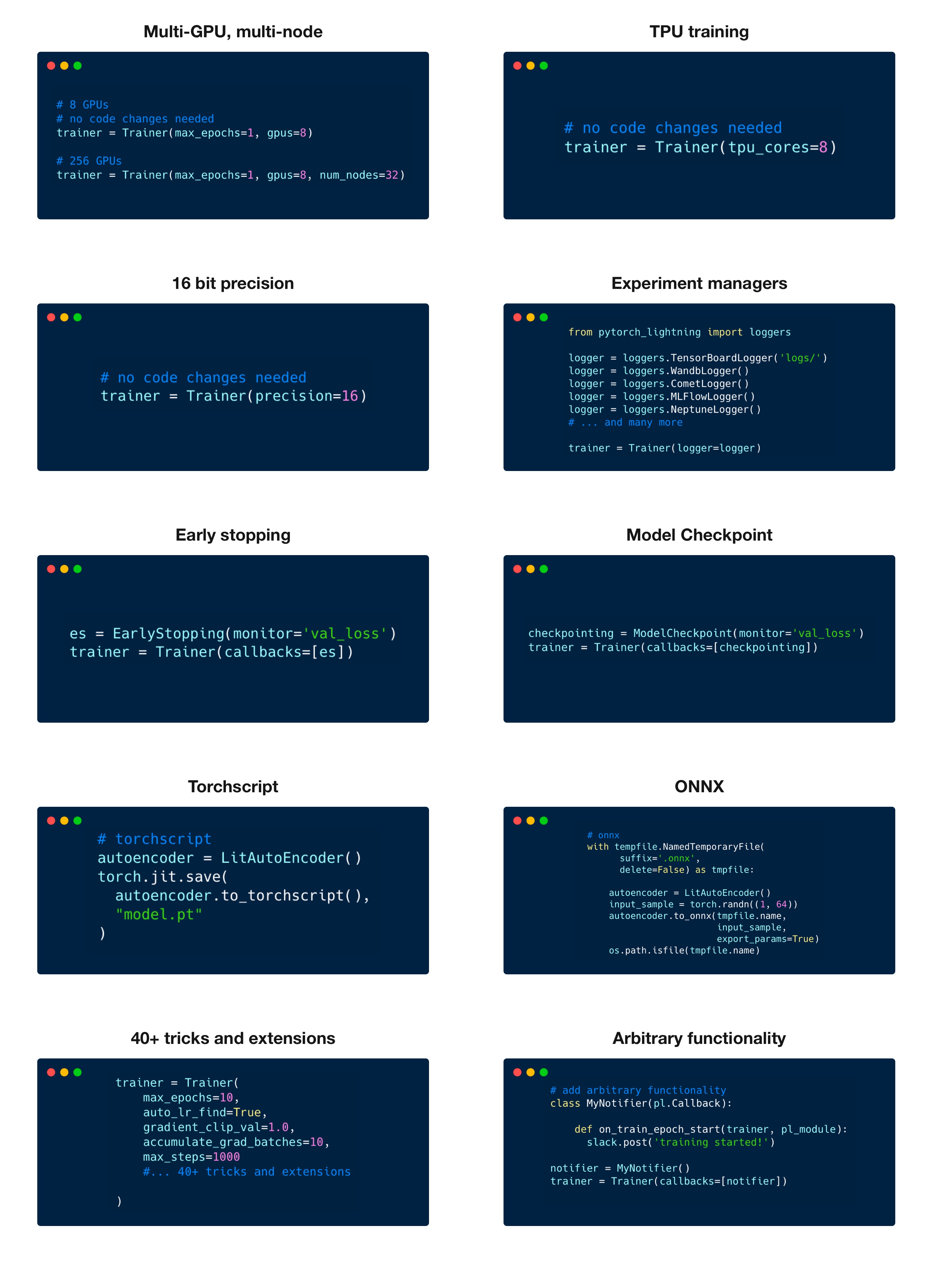
Highlighted feature code snippets
```python # 8 GPUs # no code changes needed trainer = Trainer(max_epochs=1, accelerator="gpu", devices=8)
# 256 GPUs trainer = Trainer(max_epochs=1, accelerator="gpu", devices=8, num_nodes=32) ```
```python # no code changes needed trainer = Trainer(accelerator="tpu", devices=8) ```
```python # no code changes needed trainer = Trainer(precision=16) ```
```python from pytorch_lightning import loggers
# tensorboard trainer = Trainer(logger=TensorBoardLogger("logs/"))
# weights and biases trainer = Trainer(logger=loggers.WandbLogger())
# comet trainer = Trainer(logger=loggers.CometLogger())
# mlflow trainer = Trainer(logger=loggers.MLFlowLogger())
# neptune trainer = Trainer(logger=loggers.NeptuneLogger())
# ... and dozens more ```
```python es = EarlyStopping(monitor="val_loss") trainer = Trainer(callbacks=[es]) ```
```python checkpointing = ModelCheckpoint(monitor="val_loss") trainer = Trainer(callbacks=[checkpointing]) ```
```python # torchscript autoencoder = LitAutoEncoder() torch.jit.save(autoencoder.to_torchscript(), "model.pt") ```
```python # onnx with tempfile.NamedTemporaryFile(suffix=".onnx", delete=False) as tmpfile: autoencoder = LitAutoEncoder() input_sample = torch.randn((1, 64)) autoencoder.to_onnx(tmpfile.name, input_sample, export_params=True) os.path.isfile(tmpfile.name) ```
### Pro-level control of training loops (advanced users)
For complex/professional level work, you have optional full control of the training loop and optimizers.
```python class LitAutoEncoder(pl.LightningModule): def __init__(self): super().__init__() self.automatic_optimization = False
def training_step(self, batch, batch_idx): # access your optimizers with use_pl_optimizer=False. Default is True opt_a, opt_b = self.optimizers(use_pl_optimizer=True)
loss_a = ... self.manual_backward(loss_a, opt_a) opt_a.step() opt_a.zero_grad()
loss_b = ... self.manual_backward(loss_b, opt_b, retain_graph=True) self.manual_backward(loss_b, opt_b) opt_b.step() opt_b.zero_grad() ```
______________________________________________________________________
## Advantages over unstructured PyTorch
- Models become hardware agnostic - Code is clear to read because engineering code is abstracted away - Easier to reproduce - Make fewer mistakes because lightning handles the tricky engineering - Keeps all the flexibility (LightningModules are still PyTorch modules), but removes a ton of boilerplate - Lightning has dozens of integrations with popular machine learning tools. - [Tested rigorously with every new PR](https://github.com/Lightning-AI/lightning/tree/master/tests). We test every combination of PyTorch and Python supported versions, every OS, multi GPUs and even TPUs. - Minimal running speed overhead (about 300 ms per epoch compared with pure PyTorch).
______________________________________________________________________
## Examples
###### Self-supervised Learning
- [CPC transforms](https://lightning-bolts.readthedocs.io/en/stable/transforms/self_supervised.html#cpc-transforms) - [Moco v2 tranforms](https://lightning-bolts.readthedocs.io/en/stable/transforms/self_supervised.html#moco-v2-transforms) - [SimCLR transforms](https://lightning-bolts.readthedocs.io/en/stable/transforms/self_supervised.html#simclr-transforms)
###### Convolutional Architectures
- [GPT-2](https://lightning-bolts.readthedocs.io/en/stable/models/convolutional.html#gpt-2) - [UNet](https://lightning-bolts.readthedocs.io/en/stable/models/convolutional.html#unet)
###### Reinforcement Learning
- [DQN Loss](https://lightning-bolts.readthedocs.io/en/stable/losses.html#dqn-loss) - [Double DQN Loss](https://lightning-bolts.readthedocs.io/en/stable/losses.html#double-dqn-loss) - [Per DQN Loss](https://lightning-bolts.readthedocs.io/en/stable/losses.html#per-dqn-loss)
###### GANs
- [Basic GAN](https://lightning-bolts.readthedocs.io/en/stable/models/gans.html#basic-gan) - [DCGAN](https://lightning-bolts.readthedocs.io/en/stable/models/gans.html#dcgan)
###### Classic ML
- [Logistic Regression](https://lightning-bolts.readthedocs.io/en/stable/models/classic_ml.html#logistic-regression) - [Linear Regression](https://lightning-bolts.readthedocs.io/en/stable/models/classic_ml.html#linear-regression)
______________________________________________________________________
## Community
The PyTorch Lightning community is maintained by
- [10+ core contributors](https://pytorch-lightning.readthedocs.io/en/latest/governance.html) who are all a mix of professional engineers, Research Scientists, and Ph.D. students from top AI labs. - 680+ active community contributors.
Want to help us build Lightning and reduce boilerplate for thousands of researchers? [Learn how to make your first contribution here](https://devblog.pytorchlightning.ai/quick-contribution-guide-86d977171b3a)
PyTorch Lightning is also part of the [PyTorch ecosystem](https://pytorch.org/ecosystem/) which requires projects to have solid testing, documentation and support.
### Asking for help
If you have any questions please:
1. [Read the docs](https://pytorch-lightning.rtfd.io/en/latest). 1. [Search through existing Discussions](https://github.com/Lightning-AI/lightning/discussions), or [add a new question](https://github.com/Lightning-AI/lightning/discussions/new) 1. [Join our Slack community](https://www.pytorchlightning.ai/community).